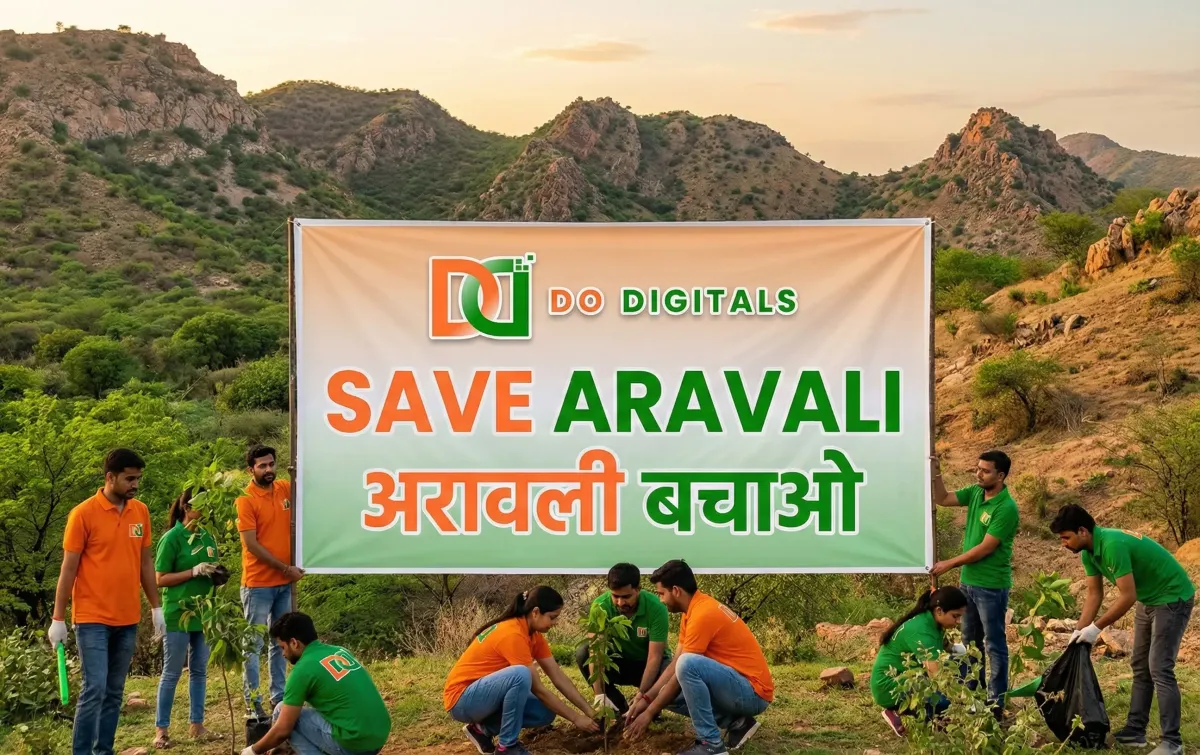
The Silent Sentinel: Why Saving the Aravali Hills is Not Just an Option, It’s a Survival Necessity By: Do Digitals Team | Estimated Reading Time: 12 Minutes | Category: Environment & Sustainability
Imagine standing before a guardian that has protected civilization for over 3 billion years. Before the majestic Himalayas rose from the ocean, before the dinosaurs walked the earth, and long before human history even began, the Aravali Range stood tall, weathering the test of time.
Today, that ancient guardian is dying. And if it falls, it takes our cities, our climate, and our future down with it.
At Do Digitals, our core mission is building the future through technology. But we also acknowledge a harsh reality: there can be no "Smart City" without a sustainable environment. Today, we are stepping away from codes, servers, and digital marketing to talk about our very survival. This is the untold story of the Aravali Hills—their glorious history, their brutal destruction, and why we must act before it is too late.
The Ancient Giant: A Geological History Older Than Time Most people mistakenly believe the Himalayas are India's oldest mountains. Geologically speaking, they are wrong.
The Aravali Range is the oldest fold mountain system in India and one of the oldest on the entire planet. Geologists estimate its age to be roughly 3.2 billion years. To put that massive timeline into perspective:
The Himalayas are roughly 50 million years old (they are essentially "infants" in geological time).
The Aravalis witnessed the formation of the Earth's early crust and the shifting of supercontinents.
Spanning approximately 692 kilometers, the range runs diagonally through Delhi, southern Haryana, and Rajasthan, finally ending in Gujarat. Historically, these hills were not just lifeless rocks; they were the towering fortresses that allowed early Indian civilizations to flourish safely behind them.
The "Green Wall": Protecting North India from the Desert Why is a range of eroded, rocky hills so critically important for a booming tech hub like Gurugram (Gurgaon) or a heritage city like Jaipur? The terrifying answer lies to the west: The Thar Desert.
The Aravali Range acts as a natural "Green Wall" that divides the arid, scorching sands of the Thar Desert from the fertile, life-sustaining plains of eastern Rajasthan, Haryana, and the National Capital Region (NCR).
The Barrier Effect: Without the Aravalis blocking the wind, the Thar desert would relentlessly expand eastward. Scientists and environmentalists warn that the desert is already migrating through the gaps created by mining. If the hills vanish completely, the blinding sandstorms (Aandhi) that occasionally hit Jaipur and Delhi will become a permanent, daily reality.
The Ultimate Water Tower: The fractures, cracks, and fissures in the ancient Aravali rocks act as a massive natural sponge. During the monsoon, they absorb rainwater and recharge the groundwater aquifers for the entire NCR. Just as we build strong backend foundations in Web Development, nature needs its foundation too. When we dynamite and blast these rocks, we destroy our own underground water tank.
The Biodiversity Vault: A Thriving Ecosystem Despite facing a harsh, semi-arid climate, the Aravalis are home to a surprisingly rich, resilient, and unique ecosystem. This vital green lung is the natural habitat of apex predators and rare species, including:
The elusive Indian Leopard
The Striped Hyena and Golden Jackal
Hundreds of species of native birds, reptiles, and medicinal flora like the Dhok and Khejri trees.
More importantly, the Aravalis serve as a crucial wildlife corridor connecting major conservation areas like the Sariska Tiger Reserve to the Delhi Ridge. Losing this continuous corridor means trapping wildlife in shrinking pockets, which directly leads to increased, fatal man-animal conflicts in expanding urban areas.
The Destruction: How We Are Assassinating Our Guardian Satellite imagery of the Aravali range over the last 30 years presents a terrifying picture. What was once a continuous, impenetrable green chain is now broken by massive, unnatural gaps. How did we get here?
Rampant Illegal Mining: The hills are incredibly rich in quartzite, silica, and pink sandstone. To feed the insatiable hunger of our real estate boom and build our concrete jungles, we are mercilessly crushing the very mountains that allow us to live. In many districts, entire hillocks have literally vanished from the map, leaving behind toxic craters.
Real Estate Encroachment & Waste Dumping: Luxury farmhouses, illegal resorts, and private compounds are eating into legally protected forest land. Furthermore, massive landfills (like the Bandhwari waste plant) are actively poisoning the pristine groundwater that flows through the hills. The "lungs" of our cities are being choked by concrete and plastic.
The Consequences: A Dystopian Future We Cannot Afford If the #SaveAravali movement fails, the consequences will not be theoretical debates for future generations; they will be personal, immediate, and catastrophic for us.
Rapid Desertification: The ecological buffer will be gone. Sand dunes will shift closer to our cities, destroying agricultural land and plunging urban centers into permanent dust bowls.
The "Day Zero" Water Crisis: Without the Aravali recharge zone, mega-cities like Jaipur, Gurugram, and South Delhi will face "Day Zero"—a scenario where taps run completely dry, and groundwater is exhausted.
Toxic Air Pollution: The hills currently block toxic particulate matter and dust from the west. Without them, the Air Quality Index (AQI) in North India will rise to levels incapable of sustaining human life.
Do Digitals Stands for the Aravalis At Do Digitals, we architect software, engineer digital solutions, and design digital ecosystems. But we deeply understand one absolute truth: Technology cannot replace nature.
"You cannot code a tree. You cannot download clean air. You cannot debug a dying planet."
We pledge to use our digital platform, our reach, and our voice to raise awareness. We urge our clients, our tech partners, and the entire corporate community to support sustainable practices. Development that systematically destroys nature is not development; it is self-destruction.
Conclusion: The Final Wake-Up Call The Aravali Hills have stood guard for 3.2 billion years. They survived devastating ice ages, meteor strikes, and the shifting of tectonic plates. But shockingly, they might not survive human greed.
We are the very last generation that has a realistic chance to save this ancient legacy. Let us not be remembered as the generation that selfishly sold our "Lungs" in exchange for "Land."
Save Aravali. Save Our Future.

Let's discuss your digital transformation.

© Copyright 2026 By Do Digitals. All Rights Reserved.